2026-07-06
Codex Handoff signals the future of persistent AI coding.
Codex Handoff highlights a bigger shift in AI coding: tasks should continue across devices and hosts. wemux turns that idea into one-click transfer for real AI work.
Founder Note
If an AI coding task dies when the laptop closes, it is still operating like a demo. Persistent work needs continuity across time, devices, and real execution surfaces.
Published 2026-07-07 · Updated 2026-07-07 · By wemux Founding Team
Point of View
AI work should behave like durable delivery work, not like a temporary browser interaction.
Key Claim
If the task dies when the laptop sleeps, the workflow is still demo-grade rather than delivery-grade.
One of the easiest ways to spot the gap between AI demos and AI work is to ask a simple question:
What happens when the laptop closes?
For a lot of AI coding tools, the answer is disappointing. The task stops. The environment disappears. The half-finished execution is stuck on one device, owned by one local process, at one moment in time.
That is not how real engineering work behaves. Real work survives context switches, teammate handoffs, machine restarts, and the end of a workday. If AI coding is going to become part of a serious delivery workflow, it has to survive those same boundaries.
Most conversations about AI coding still focus on model intelligence: better reasoning, better tool use, better code generation. Those improvements matter, but they are not the full story.
Teams usually get blocked later:
In other words, the limiting factor is not always what the model knows. It is whether the task can keep living after the original local session stops.
This is why persistent AI coding matters. The agent should not be treated like a temporary chat tab. It should behave more like a work unit with memory, execution history, repository state, and a handoff path.
That means:
Once you see AI work through that lens, the product direction changes. You stop optimizing only for faster replies and start optimizing for continuity, routing, and recoverability.
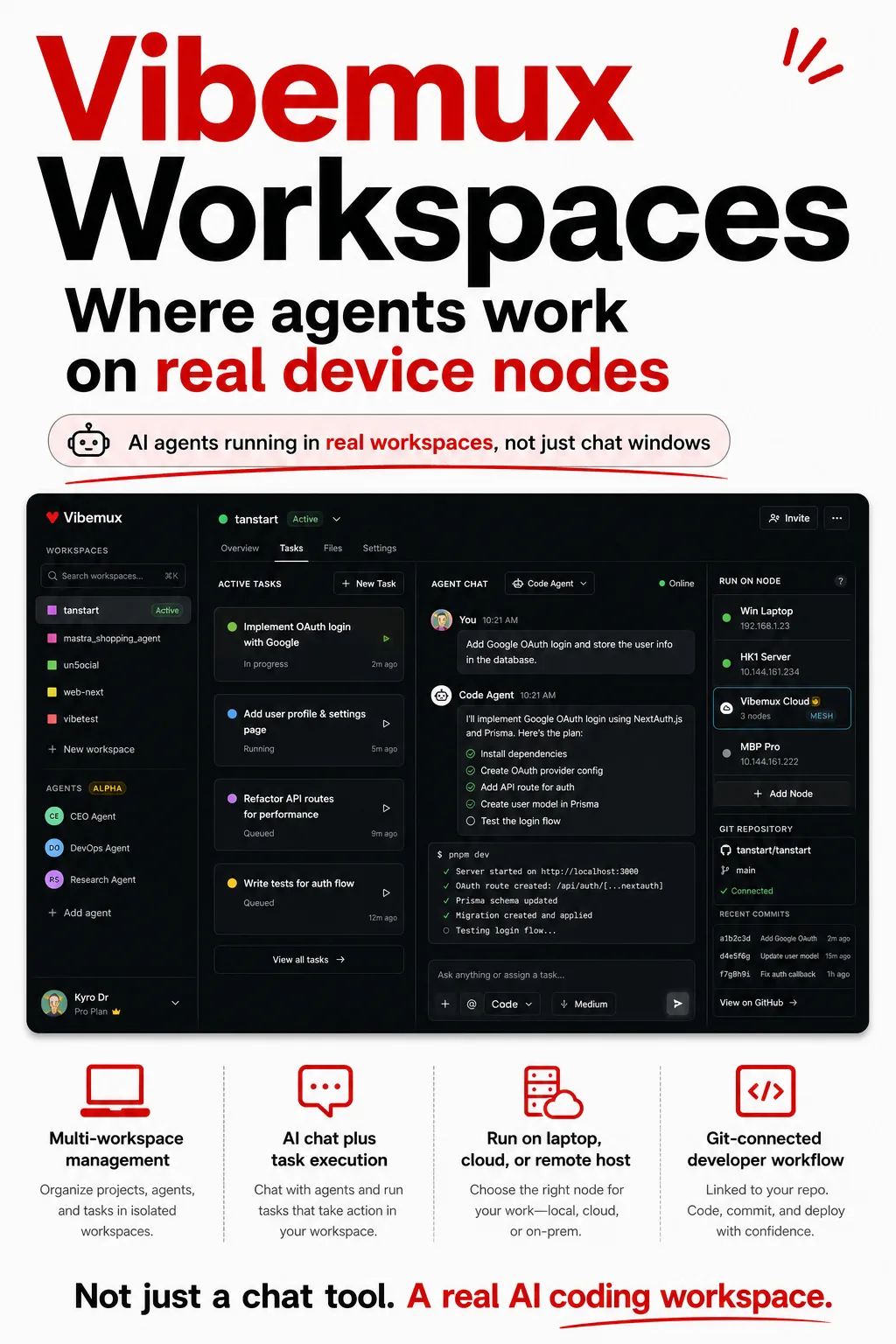
Wemux is built around real workers and real execution surfaces. That makes persistence a routing problem, not just a UI problem. If a task needs to continue after someone leaves the office, the platform should be able to send the work to the next machine that can safely continue it.
That is a much more practical framing of AI coding. The question is not “can the model keep typing?” The question is “can the work keep moving?”
For teams that actually ship code, that difference is the whole market.
These pages are discovered automatically from shared topics, so the internal linking graph grows with the content library instead of depending only on manual curation.
2026-07-06
Codex Handoff highlights a bigger shift in AI coding: tasks should continue across devices and hosts. wemux turns that idea into one-click transfer for real AI work.
2026-07-07
Compare wemux vs Orca for AI coding delivery, worktree execution, team workflows, routed workers, and persistent multi-machine development.
2026-07-07
Remote handoff will become a core AI agent primitive because useful work needs to continue across devices, hosts, and long-running workflows.
2026-07-07
Compare wemux vs Cursor for AI coding workflows, focusing on editor speed, worker routing, execution ownership, and multi-machine delivery continuity.
These pages keep the surrounding product story connected, which helps both readers and search engines navigate the topic cluster.