2026-07-07
wemux vs Orca: desktop AI workbench or routed delivery control plane?
Compare wemux vs Orca for AI coding delivery, worktree execution, team workflows, routed workers, and persistent multi-machine development.
Founder Note
Codex Handoff is a strong signal that AI coding tasks should survive device changes. wemux takes that idea further with one-click transfer across laptops, cloud servers, and remote hosts.
Published 2026-07-06 · Updated 2026-07-06 · By wemux Founding Team
Point of View
Persistent AI coding should survive device changes and continue across machines instead of dying with one laptop session.
Key Claim
Codex Handoff validates that AI coding work needs continuity across hosts, not just better chat memory.
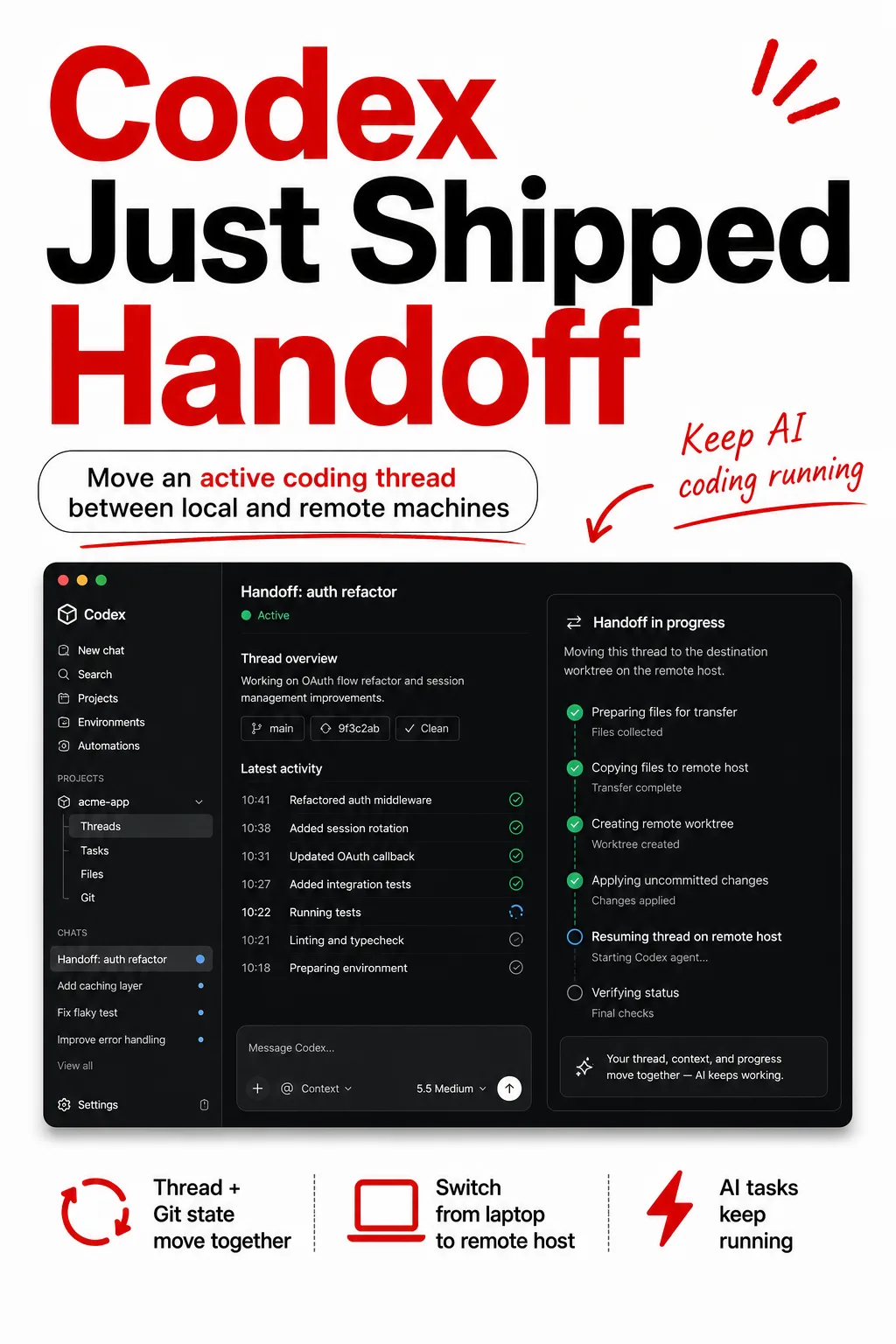
Codex recently introduced Handoff, and I think it points to something much bigger than a convenience feature.
The important idea is not remote control by itself. The real idea is continuity. An AI coding task should not stop just because the current machine becomes unavailable. If a developer starts work on a laptop and later needs to move that work to a remote host, a cloud server, or another device, the task should keep going without losing context or code state.
That is why Handoff matters. It suggests that an AI coding thread is not just a chat log. It is a real execution unit. It has conversation history, repository context, Git state, and a concrete next step. If that state can move together, the agent can continue working instead of starting over.
This is a real problem in everyday AI coding workflows.
A developer may spend the day on a MacBook reading the codebase, editing files, running tests, and fixing bugs with an agent. Then the workday ends. The laptop closes. The machine sleeps. The node disappears. And the AI task stops with it.
That is not how long-running AI work should behave.
At Wemux, we built one-click transfer to solve exactly this problem.
The goal is bigger than moving a single thread between hosts. The real goal is to migrate an active AI coding task when the current machine is about to go offline and let it continue automatically on another node.
The flow is straightforward:
From the user's perspective, it feels seamless. You can leave the office, close your laptop, and let the agent keep working on a cloud server or a home PC.
This matters because modern AI coding is not just about generating code. It is about sustained execution. Context should persist. Code state should persist. Progress should persist.
Humans switch devices all the time. AI tasks should not have to restart every time the hardware changes.
That is why Codex Handoff is such an important signal. It validates a broader shift in AI development tools. The future is not a chatbot that helps for a few minutes. The future is an AI agent that can keep working across machines, environments, and time.
Humans go offline. Devices change. AI tasks should not.
AI agent handoff is the ability to move an active AI task from one machine or environment to another without losing its working context.
Because the local execution node goes offline. If the AI task depends on that machine, the task stops with it.
Remote desktop gives a human access to a machine. Wemux is designed to transfer the AI task itself, including execution flow, code state, and context continuity.
Because real software work often runs longer than a single device session. Teams need AI tasks to continue across laptops, cloud servers, and remote hosts.
These pages are discovered automatically from shared topics, so the internal linking graph grows with the content library instead of depending only on manual curation.
2026-07-07
Compare wemux vs Orca for AI coding delivery, worktree execution, team workflows, routed workers, and persistent multi-machine development.
2026-07-07
Persistent AI coding matters because real engineering work should survive laptop sleep, device changes, and long-running execution across machines.
2026-07-07
Remote handoff will become a core AI agent primitive because useful work needs to continue across devices, hosts, and long-running workflows.
2026-07-07
Compare wemux vs Cursor for AI coding workflows, focusing on editor speed, worker routing, execution ownership, and multi-machine delivery continuity.
These pages keep the surrounding product story connected, which helps both readers and search engines navigate the topic cluster.