2026-07-06
Codex Handoff signals the future of persistent AI coding.
Codex Handoff highlights a bigger shift in AI coding: tasks should continue across devices and hosts. wemux turns that idea into one-click transfer for real AI work.
Comparison
Codex is strong as a coding runtime. wemux is stronger when the task must keep moving across workers, environments, and device changes.
Published 2026-07-07 · Updated 2026-07-07 · By wemux Editorial Team
Point of View
Strong coding runtimes still need an execution and delivery layer when tasks span machines and sessions.
Key Claim
Codex is a strong runtime, while wemux makes the work persistent across workers and device changes.
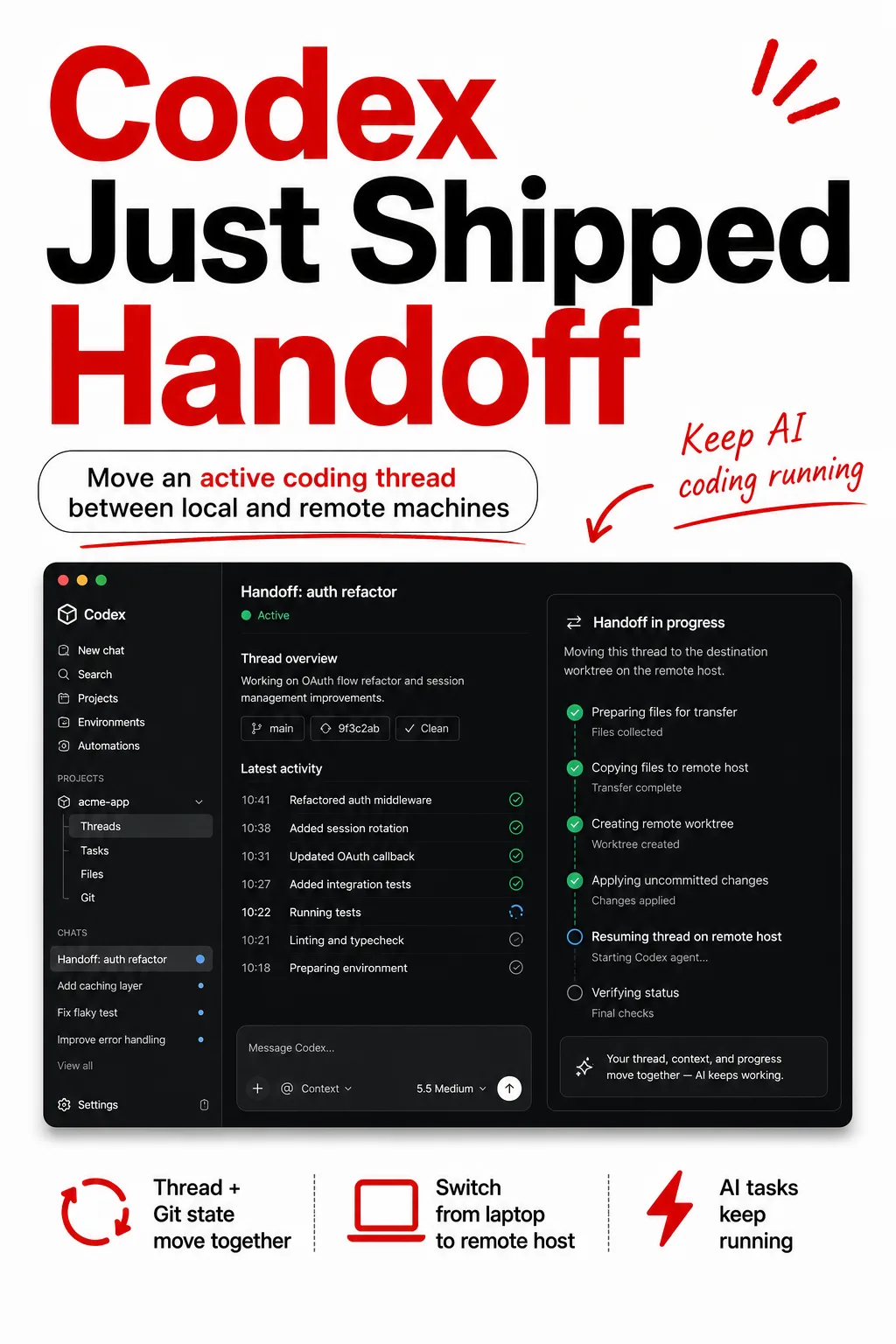
Codex is powerful as a coding runtime. It is especially strong when a developer wants a direct AI coding session that can reason about code, edit files, and work through implementation tasks in a focused environment.
Wemux does not try to replace that runtime. It tries to solve what happens around it when the work becomes bigger than one session on one device.
Codex is strong at the agent-runtime layer:
If your main need is “I want a strong coding agent to work through the code with me,” Codex is a strong fit.
Wemux is built around the delivery workflow that surrounds runtimes like Codex:
That difference matters because many AI coding tasks are not blocked by intelligence alone. They are blocked by machine ownership, environment drift, handoff friction, and lack of reviewable execution evidence.
| Dimension | Codex | Wemux |
|---|---|---|
| Product shape | Coding agent runtime | Worker-routed AI delivery platform |
| Best fit | A developer directly driving one agent session | Teams or operators managing execution across real machines |
| Main value | Strong coding interaction and implementation help | Routed execution, persistence, and reviewable delivery flow |
| Session model | Strong inside one runtime context | Stronger across tasks, workers, sessions, and device changes |
| Machine continuity | Limited compared with a worker control plane | Explicitly built for multi-machine continuation and handoff |
| Human visibility | Often centered on the current operator | Better aligned with shared execution context and delivery evidence |
Choose Codex if your main problem is selecting a strong coding runtime for individual work.
Choose Wemux if your main problem is making AI coding durable and operational across workers, environments, and delivery workflows.
This is not really “runtime versus runtime.” It is “runtime versus delivery layer.”
Codex can be the engine. Wemux is the system around the engine when you need:
That is why Wemux fits teams who no longer just want AI coding sessions. They want AI coding work that can keep moving after the first session ends.
These pages are discovered automatically from shared topics, so the internal linking graph grows with the content library instead of depending only on manual curation.
2026-07-06
Codex Handoff highlights a bigger shift in AI coding: tasks should continue across devices and hosts. wemux turns that idea into one-click transfer for real AI work.
2026-07-07
Compare wemux vs Orca for AI coding delivery, worktree execution, team workflows, routed workers, and persistent multi-machine development.
2026-07-07
Persistent AI coding matters because real engineering work should survive laptop sleep, device changes, and long-running execution across machines.
2026-07-07
Remote handoff will become a core AI agent primitive because useful work needs to continue across devices, hosts, and long-running workflows.
These pages keep the surrounding product story connected, which helps both readers and search engines navigate the topic cluster.